
Elder Law & Estate Planning
Request Consultation

Virtual Reality and Palliative Care

You’re walking along a coastline where forest meets sea. You hear the rhythm of crashing waves and see gulls swooping down from a crystal blue sky. A light breeze ruffles your jacket. You take a deep breath of the salty, pungent air and watch as a foaming wave washes away your footsteps and sweeps the sands clean, leaving behind a shimmering, vitreous surface that reflects a pale white sun.
Posted on November 4, 2024
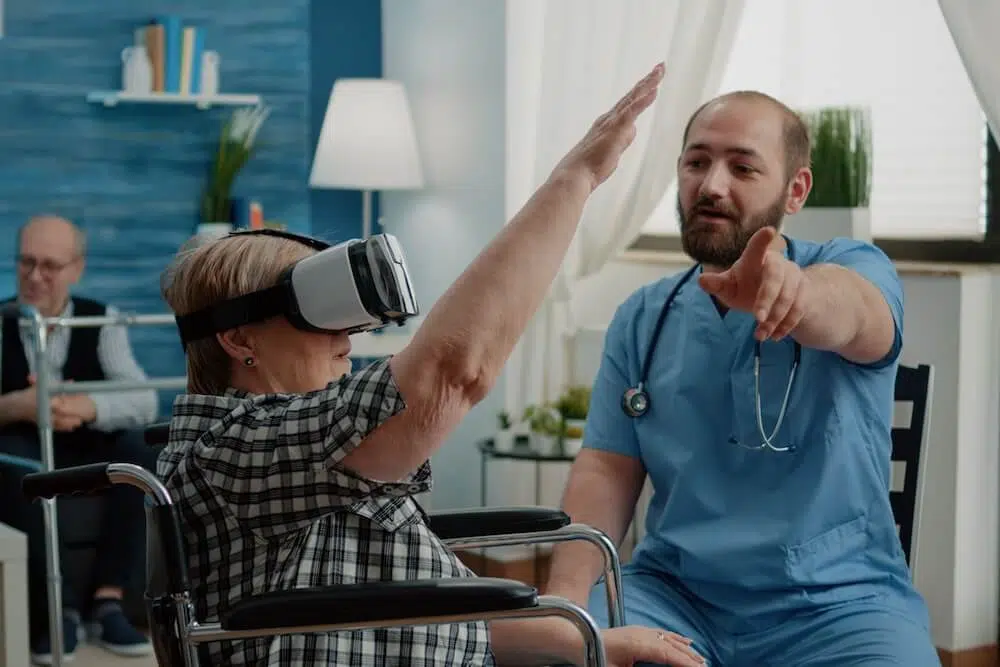
A patient wearing a virtual reality headset, depicting the use of VR technology in palliative care for improving patient comfort and well-being.

The next thing you know, you’re in an examination room, the sun’s rays replaced by overhead fluorescent lighting. A nurse is standing next to you. She removes your headset and asks how you’re feeling.

This is not a scene from a futuristic sci-fi movie. It’s an illustration of how virtual reality (VR) is currently being used for palliative care treatment. Although VR in palliative care is still considered experimental, early research shows that it can improve patient outcomes.

How VR Is Being Used in Palliative Care

Popular in video gaming and entertainment, VR has more recently been deployed in health care for a variety of purposes, from treating phobias and PTSD to training physicians.

An increasing number of palliative care professionals are utilizing VR in their practices. Palliative care is specialized medical care that focuses on treating the physical and emotional suffering of patients living with serious illnesses. While it can be provided at the end of life, palliative care is not limited to that stage. It can be given to the patient in the home as an inpatient, or as an outpatient at a hospital or a specialized clinic such as a hospice.

VR technology allows users to interact with a computer-generated, immersive environment using a headset like the Microsoft HoloLens, the Meta Quest, and the Oculus VR device. The computer-generated, customizable simulated environments can be personalized to the user, allowing them to do things in a virtual world that they cannot do physically in the real world. This can be particularly valuable to palliative care patients, many of whom have limited mobility and are home or bedbound.

VR Can Enhance Patient Comfort and Quality of Life

Demand for palliative care is increasing as the global population ages. Palliative care is widely considered a human right, but the World Health Organization estimates that only around 14 percent of the roughly 60 million people who need palliative care each year worldwide receive it.

VR has shown potential as an alternative to the high-cost pain therapy services and medications that palliative care patients typically receive. The executive vice president and chief medical officer of VITAS Healthcare, the largest provider of hospice care in the United States, said that “VR technology can deliver surprising results at a relatively low cost and with little training required for caregivers.”

    FREE WEBINAR

    5 Things to Know About

    Estate Planning

    When You Turn Sixty-Five

    Save the Date

    Friday, Sep 18th at 2:30pm


    FREE WEBINAR

    5 Things to Know About

    Estate Planning

    When You Turn Sixty-Five


      Save the Date

      Friday, Sep 18th at 2:30pm


      An article in The Conversation describes how this is being done. Palliative care staff in an acute ward gave patients three 20-minute VR sessions. They worked with the patients to create a VR experience tailored to them, including a walk through the streets of Paris and a VR Star Wars Game, and asked them before and after each session how they felt.

      The results, published in the journal BMJ Supportive & Palliative Care, were promising. More than 50 percent of patients experienced “clinically meaningful” reductions in pain and depression immediately following a 20-minute VR session.

      One patient told the researchers, “When the service is finished you feel like you’re floating.” A second patient said, “Oh, it’s just amazing, it was nothing like I expected […] it takes you from this world into another beautiful world.”

      In addition to immediate relief from their physical and emotional discomfort, VR can give patients access to experiences and places on their bucket list and help them to achieve a last wish, improving their quality of life through a peaceful escape — if only in a virtual environment.

      VR headsets also enable patients to engage in activities like working in the garden and stacking blocks that can support brain and body health. They can be programmed with images of a patient’s family and slideshows of their life and even allow families to share experiences that are not otherwise possible, such as traveling together to a remote destination or revisiting a childhood home.

      Positive patient outcomes like those measured in the BMJ study have been reported elsewhere:

      • A study published in BMC Palliative Care found that around 17.5 percent of participants reported lower rates of pain-related sleep impairment after a virtual reality session, while about 82.5 percent reported feeling “joy” or “happiness.”
      • A second study found that close to 88 percent of palliative patients who used VR reported physical and/or psychological symptom relief.
      • The authors of the BMC Palliative Care study reviewed several other studies on palliative care VR interventions published between 2012 and 2021. The patients in these studies, who had a wide range of illnesses and ages, reported improved pain management, reduced feelings of anxiety and depression, a “significant improvement” in quality of life, and positive behavioral changes.
      • A data analysis of 31 studies on VR and palliative care concluded that VR eases the pain and distress of patients with conditions like cancer, dementia, kidney disease, and multiple sclerosis. The researchers suggest that VR might be able to reduce the subjective experience of pain or boost a patient’s ability to cope with their physical and psychological symptoms by distracting them and altering their state of mind.

      Not all patients enjoy the VR experience. Some have told researchers the simulated world made them feel worse or that the headset was uncomfortable. However, new technologies are being developed to suit the needs of palliative care patients.

      Stay updated on how to protect everything you’ve worked for so hard during your life.


        A clinic in Australia, for example, replaced their older VR equipment with new headsets that are light and wireless. Specific VR therapies are being developed to help patients in palliative care as well. Flourishing-Life-of-Wish Virtual Reality Relaxation Therapy (FLOW-VRT-Relaxation) is a treatment that combines traditional relaxation breathing practice with panoramic video played on a headset. And VITAS Healthcare is teaming up with AT&T to develop therapies that use 5G virtual and augmented reality systems.

        Researchers caution that, despite its demonstrated potential as an alternative therapy, VR is just one tool in the palliative care team’s toolbox of treatment options. They say it requires further study to develop more standard treatment protocols and to determine what side effects or long-term effects there might be.

        Ways to Access VR Palliative Care

        If you or a loved one is interested in accessing VR as part of your palliative care plan, inquire with hospitals and clinics or consult with your health care provider about potential options.

        Patients can also reach out directly to a VR company such as Guided VR or Rendever and ask about any solutions they offer for palliative care. In addition, it might be possible to work with a caregiver who is trained to use VR in palliative care or participate in a clinical trial or similar study.

        More from our blog...

        Person sitting alone at a table with documents and a window view representing aging alone estate planning in New Jersey

        Aging Alone: What to Do Legally and Financially When There Is No Spouse or Partner to Plan With

        September 13, 2026
        According to the Pew Research Center, roughly 26 percent of Americans ages 65 and older lived alone in 2023. Census Bureau research has also found…
        Close-up of lush green leaves representing the idea that estate planning documents are built for living, not just for what happens at death.

        Estate Planning Is Built Around Death. But What About Everything That Comes Before It?

        September 10, 2026
        A recent Forbes article by John Samuels, founder and CEO of the healthcare advisory firm Wellworth, makes a case that the estate planning industry has…
        lose-up of a weathered brick wall with the words "Step-Up In Basis" — what the step-up in basis rule means for inherited property and how it affects capital gains taxes in New Jersey

        What Is a Step-Up in Basis and Why Does It Matter When You Inherit?

        September 4, 2026
        When you inherit a piece of real estate or a brokerage account, the tax basis of that asset is generally adjusted to its fair market…
        Shadows of a multigenerational family walking together on pavement with the words "While There Is Time" — what families in New Jersey should do legally and financially as parents get older

        My Parents Are Getting Older. What Should We Be Doing Now?

        August 31, 2026
        The worry usually arrives quietly. A parent forgets something they would not have forgotten before. A bill goes unpaid. A conversation reveals that they have…
        Back To blog

        Table of Contents

        FREE WEBINAR

        5 Things to Know About

        Estate Planning

        When You Turn Sixty-Five


          Save the Date

          Friday, Sep 18th at 2:30pm

          Privacy Policy

          This Privacy Statement describes how Milvidskiy Law Group P.C. collects, uses, and discloses certain personal information obtained through our public web site at www.milvidlaw.com (the “Web Site”). This Privacy Statement does not address information collection through other sources such as in-person seminars, workshops, or in-person consultations and contacts.

          SMS Privacy Policy

          Milvidskiy Law Group P.C. may disclose Personal Data and other information as follows:

          Third Parties that Help Provide the Messaging Service: We will not share your opt-in to an SMS short code campaign with a third party for purposes unrelated to supporting you in connection with that campaign. We may share your Personal Data with third parties that help us provide the messaging service, including, but not limited to, platform providers, phone companies, and other vendors who assist us in the delivery of text messages.

          Additional Disclosures: Affiliates: We may disclose the Personal Data to our affiliates or subsidiaries; however, if we do so, their use and disclosure of your Personal Data will be subject to this Policy. All the above categories exclude text messaging originator opt-in data and consent; this information will not be shared with any third parties.

          Personal Information Collection and Use

          In general, you can visit our Web Site without telling us who you are or revealing any information about yourself. There are times, however, when we ask for personally identifiable information from you, such as your name, company, e-mail address, phone number, and address (“Personal Information”). We request this information in order to correspond with you, to provide you with a subscription to a newsletter or publication, to notify you about events, or otherwise to respond to your requests or provide you with information that we consider may be of interest to you. Where applicable, we will differentiate between personal data fields that are optional and those that are mandatory to obtain the requested information.

          If you receive a marketing e-mail from Milvidskiy Law Group P.C., you will be provided with an automated way to opt out (unsubscribe) from that particular communication or from all marketing e-mails sent by our firm. Please follow the instructions on the e-mail you received. If you have received unwanted e-mail from our firm, please forward a copy of that e-mail to [email protected].

          Please note that if you reply to a Milvidskiy Law Group P.C. address in one of our marketing e-mails or otherwise send a communication to us, your communication will not create an attorney-client relationship with us. Do not send us any information that you or anyone else considers to be confidential or secret unless we have first agreed to be your lawyers in that matter. Any information you send us before we agree to be your lawyers cannot be protected from disclosure.

          Data Sharing

          We may share Personal Information among our member attorneys for purposes of responding to your requests or otherwise as necessary for the purposes described above. We may also in limited circumstances share Personal Information with government authorities or others as required to protect the interests of the firm or others, as necessary in connection with the sale or transfer of all or a portion of the business, or as required by applicable law or court order.

          International Data Transfers

          This Web Site is hosted on a web server in the United States. If you are located in a non-US jurisdiction, your provision of Personal Information or other access to our Web Site constitutes your transfer of such data to the United States, a jurisdiction that may not provide a level of data protection equivalent to the laws in your home country.

          Security Measures

          Milvidskiy Law Group P.C. maintains appropriate technical and organizational security measures to protect the security of your Personal Information against the loss, misuse, unauthorized access, disclosure or alteration.

          Links to Other Web Sites

          The privacy practices set forth in this Privacy Statement are for our web site only. This web site may contain links to other sites. Milvidskiy Law Group P.C. is not responsible for the privacy practices or the content of such sites. If you link to or otherwise visit any other site, please review the privacy policies posted at that site.

          Cookies and Passive Tracking

          A “cookie” is an element of data that can be sent to your browser. Your browser may then store it on your system based on the preferences you have set on your browser. Cookies gather information about your operating system including, but not limited to, browser type, and Internet Protocol (IP) address. The Web Site uses this information to analyze the traffic on our web site, and better serve you when you return to our web site. It is not our intention to use such information to personally identify a user. You have the option to configure your Internet browser to notify you when you receive a cookie, giving you the chance to decide whether to accept it. Further, you have the option to block all cookies. Please note, however, that if you refuse or otherwise block cookies you may not be able to use all of the functionality available on the web site.

          Access and Correction

          If you wish to access or update the Personal Information you submit through our web site, or to make any inquiries about the processing of such information, please contact us as described below. We provide individuals with access to their Personal Information where we believe appropriate, including in situations where you are entitled to access and review your Personal Information under applicable data protection and privacy laws.

          Google ReCaptcha Spam Protection

          This site is protected by reCAPTCHA and the Google.
          Privacy Policy and
          Terms of Serice apply.

          Revisions to this Privacy Statement

          Milvidskiy Law Group P.C. reserves the right to change this Privacy Policy from time to time. Please check the Privacy Statement frequently and particularly before you submit additional personal information via the Web Site. All revisions to this Privacy Statement will be posted on the web site via a link from the homepage. We also display the effective date of the Privacy Statement on the top of this page.

          Close

          Disclaimer

          Attorney Advertising. The information presented on this website is for informational purposes only and should not be construed as a legal advice. Viewing of, responding to, or otherwise transmitting the information on this website is not intended to create, and receipt of the same does not constitute, an attorney-client relationship. The information provided on this website should not be relied upon without first seeking professional legal counsel. The information on this website is provided only as general information which may or may not reflect the most current developments of law. Prior results and cases discussed on this website do not imply and do not guarantee a similar outcome in any other case. The links to other websites contained herein do not constitute a referral or endorsement of any kind.
          Close
          Sign up for our newsletter to be updated on all the latest news in Elder Law and Estate Planning.

            Every plan starts with a conversation. Tell us a little about your situation, and our Client Services Coordinator will reach out to help you schedule your consultation.

              This site is protected by reCAPTCHA and the Google.
              Privacy Policy and Terms of Service apply.

              Open chat Call us Close chat
              Start a conversation
              Team member Team member Team member
              Contact us to protect what matters most to you and your loved ones